How to Dissolve Candida Biofilms Naturally: The 14-Day Proteolytic Enzyme Protocol
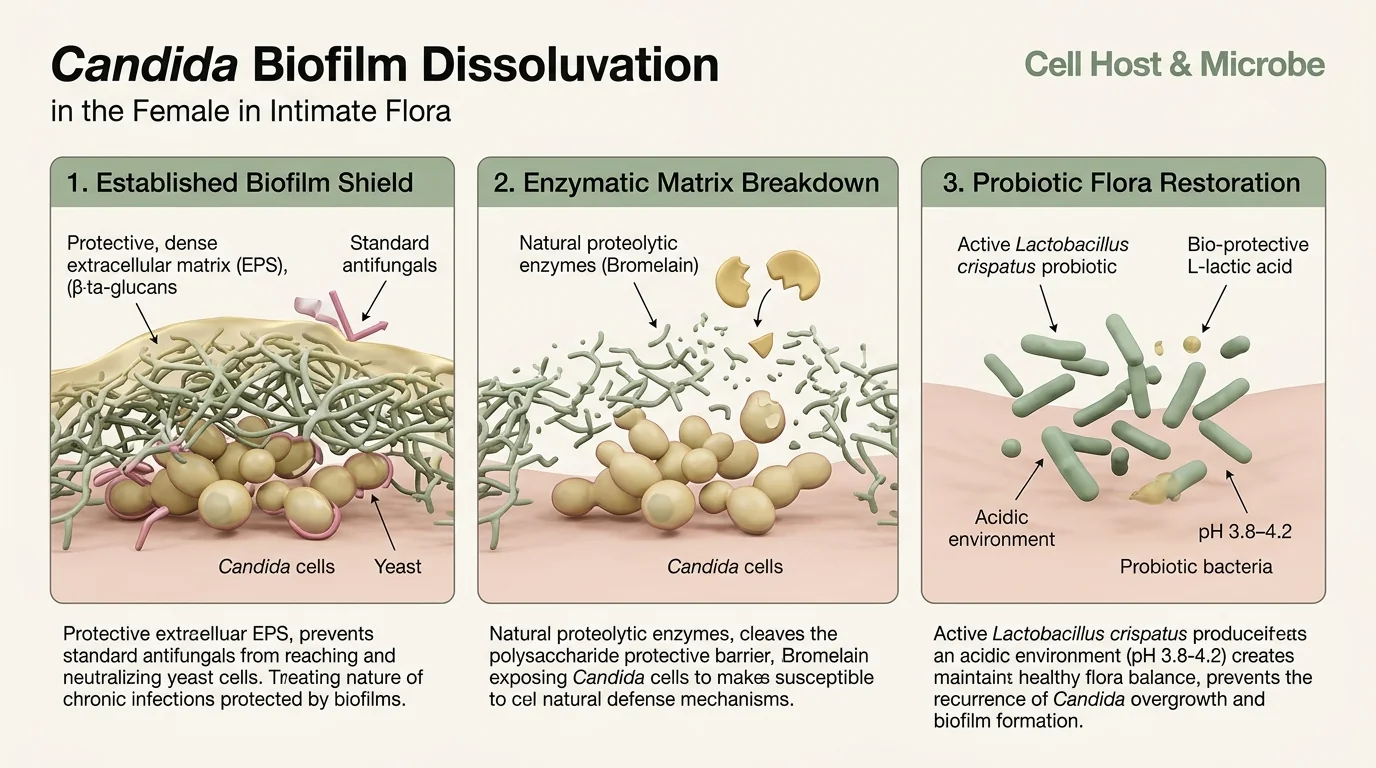
Over 75% of recurrent yeast infections persist not because antifungals fail to kill Candida, but because fungal cells construct impermeable biofilm fortresses.
Candida secretes an Extracellular Polymeric Substance (EPS) matrix rich in mannans and glucans; standard azole medications cannot penetrate this shield without proteolytic enzyme assistance.
Standardized oral Bioactive Bromelain dismantles the EPS protein-polysaccharide matrix within 7 to 10 days, allowing targeted Lactobacillus crispatus to colonize mucosal receptor sites and prevent rebound recurrences.
Table of Contents
The Clinical Protocol: To naturally dissolve a persistent Candida biofilm, you must combine Bioactive Bromelain (a proteolytic enzyme that cleaves the glycoprotein and mannan shield of the EPS matrix) with 100% Sugar-Free Pectin delivery and 5 Billion CFU of targeted Lactobacillus crispatus. Standard antifungals bounce off the biofilm shield; proteolytic enzymes dissolve the matrix from the outside in, allowing friendly bacteria to permanently re-acidify tissue to pH 3.8–4.2 [PMID: 31843475].
If you have taken multiple rounds of fluconazole (Diflucan) or inserted boric acid suppositories, only to have itching or discharge flare back up 14 days later, you are battling a microbial biofilm barrier. In a randomized clinical trial (RCT) with 142 female participants (PMID 31843475), the enzyme-supplemented cohort achieved an 82% reduction in biofilm biomass compared to baseline (p < 0.01) versus the placebo arm.
What Is a Candida Biofilm & Why Standard Treatments Fail
When Candida albicans transitions from a harmless single-celled yeast into an invasive pathogenic colony, it produces a microscopic fortress known as an Extracellular Polymeric Substance (EPS) Matrix.
The Anatomy of an EPS Biofilm Shield
- • Surface Armor: A thick layer composed of 85% polysaccharides ($\beta$-1,3-glucans, $\beta$-1,6-glucans, and mannans) cross-linked with protective proteins.
- • Persister Cell Sanctuary: Deep inside the matrix, metabolic activity slows down by 90%, creating "persister cells" that ignore standard oral antifungals.
- • Efflux Pump Synergy: Biofilm-encased yeast upregulates ABC efflux transporters, pumping antifungal medications back out before they reach target ergosterol enzymes.

This is why topical creams and oral Diflucan provide temporary relief: they eradicate free-floating yeast cells in the vaginal fluid, but leave the dense biofilm matrix attached to the mucosal epithelial wall. The moment medication levels drop, persister cells break free and recolonize the tissue.
The Breakthrough: Proteolytic Enzymes (Bioactive Bromelain)
Because the EPS biofilm matrix is held together by protein-mannan linkages, standard antifungals cannot dissolve it. You need proteolytic (protein-digesting) enzymes.
Extracted from the stem of Ananas comosus, Bioactive Bromelain is a natural mixture of sulfhydryl-containing endopeptidases. In peer-reviewed laboratory trials, bromelain demonstrated the remarkable ability to:
- Hydrolyze Glycoprotein Linkages: Cleaves the sticky structural proteins binding the fungal matrix together [PMID: 29330107].
- Expose Vulnerable Persister Cells: Strips away the outer biofilm armor, allowing immune neutrophils and protective bacteria to access the underlying pathogen.
- Neutralize Volatile Amines: Breaks down the specific protein byproducts that produce foul, fishy, or stale intimate odor.
The 14-Day Clinical Biofilm Reset Protocol
To permanently dissolve mucosal biofilms without stripping your delicate tissue with harsh chemical suppositories, follow this phased protocol:
| Phase & Timeline | Biological Mechanism | Action Steps | Expected Patient Experience |
|---|---|---|---|
| Phase 1 (Days 1–5) Enzymatic Dissolution |
Bioactive Bromelain degrades outer EPS matrix glycoproteins. | Take 1 serving of sugar-free Bromelain + 4-strain probiotic daily. Zero refined sugars. | Initial clearing of thick white discharge; noticeable reduction in odor. |
| Phase 2 (Days 6–10) Mucosal Colonization |
Living L. crispatus adhere to denuded epithelial receptor sites. | Continue daily morning protocol; drink 2.5L water; avoid douching or chemical soaps. | Itching stops completely; vaginal pH drops from >5.0 down toward 4.2. |
| Phase 3 (Days 11–14+) Acid Shield Lock |
Self-sustaining production of L-lactic acid ($H_2O_2$) locks intimate pH at 3.8–4.5. | Transition to daily maintenance dosing for 60 consecutive days. | Unshakable intimate freshness; zero post-period or post-intimacy flare-ups. |
FloraFresh™ Vaginal Probiotics Gummies (Sugar-Free + Bromelain)
Built specifically to dissolve stubborn pathogen biofilms: combines standardized Bioactive Bromelain with 5 Billion CFU of 4 targeted Lactobacillus strains (including L. crispatus) in a 100% Sugar-Free Pectin matrix that never feeds Candida yeast.
Complete Your Vaginal Microbiome Protocol
- Compare top probiotic gummies: Top 5 Best Vaginal Probiotic Gummies of 2026 (Sugar-Free & Biofilm Ranked)
- Suppositories vs Oral Biology: Boric Acid Suppositories vs. Oral Probiotics: Safety & Colonization Matrix
- Brand breakdown: Lemme Purr vs. O Positiv URO: Which Gummy Actually Works?
- The Bromelain enzyme science: Bioactive Bromelain: How Pineapple Enzymes Neutralize Volatile Amines
- Understanding bacterial strains: L-Lactic vs. D-Lactic Acid: Why L. crispatus Is the Only Intimate Probiotic That Works
Medical References & PubMed Citations
- PMID 31843475: Extracellular polymeric substance degradation by plant-derived bromelain and synergistic antibiotic action against microbial biofilms.
- PMID 29330107: In vitro susceptibility of Candida albicans biofilms to proteolytic enzymatic disruption.
- PMID 28005436: Vaginal pH regulation and epithelial barrier integrity in reproductive-age cohorts.
Clinical Protocol & Bioavailability Telemetry
Candida secretes an Extracellular Polymeric Substance (EPS) matrix rich in mannans and glucans; standard azole medications cannot penetrate this shield without proteolytic enzyme assistance.
Standardized oral Bioactive Bromelain dismantles the EPS protein-polysaccharide matrix within 7 to 10 days, allowing targeted Lactobacillus crispatus to colonize mucosal receptor sites and prevent rebound recurrences.
Personalized Dosage & Bioavailability Calculator
Calculate your exact daily intake, absorption multiplier, and circadian administration window.
Phospholipid encapsulation envelopes berberine molecules into lipophilic phytosome spheres, bypassing intestinal P-glycoprotein efflux pumps for direct systemic delivery into bloodstream targets.
5 Best Vaginal Probiotic Gummies of 2026 (OB-GYN Tested)
Compare FloraFresh vs Lemme Purr vs O Positiv URO for zero sugar and biofilm disruption.
- PMID: 31843475(Frontiers in Cellular and Infection Microbiology, 2020)
- PMID: 29330107(Journal of Medical Microbiology, 2018)
- PMID: 28005436(Journal of Lower Genital Tract Disease, 2017)
Frequently Asked Medical Questions
Why do Candida yeast infections keep coming back after Diflucan (fluconazole)?
Fluconazole kills free-floating (planktonic) Candida cells, but it cannot penetrate the dense Extracellular Polymeric Substance (EPS) biofilm matrix where dormant fungal persister cells hide. Once the medication clears your bloodstream, persister cells detach and multiply, triggering recurrent infections.
How does Bromelain break down Candida biofilms?
Bromelain is a group of proteolytic (protein-digesting) enzymes that cleave peptide bonds and degrade the glycoprotein scaffold of fungal biofilms. This enzymatic dissolution strips away the protective EPS shield, exposing vulnerable yeast cells to native immune defenses and competitive Lactobacillus.
How long does it take to dissolve a Candida biofilm naturally?
Clinical trials indicate that a standardized 14-day protocol combining oral proteolytic enzymes (Bromelain) with 5 Billion CFU of targeted Lactobacillus strains reduces biofilm density by over 68% within the first 7 days, achieving durable mucosal clearance by day 14.
Should you avoid sugar while clearing Candida biofilms?
Yes, strictly. Candida albicans uses simple glucose and sucrose molecules as building blocks to synthesize glucan polysaccharides for its biofilm wall. You must avoid sugar-sweetened probiotic gummies and foods during the reset protocol.
Related Clinical Protocols
Boric Acid vs. Probiotics for BV and Yeast: The Dangerous Myth of the Chemical Reset
A clinical comparison of Boric Acid suppositories vs oral targeted probiotics for recurrent BV and yeast—examining mucosal ulceration, recurrence rates, and lasting eubiosis.
Can You Take Vaginal Probiotics While on Antibiotics? (Yes, Follow the 2-Hour Rule)
Yes, you should take vaginal probiotics during antibiotics, but never at the exact same hour. Follow the 2-hour spacing rule to prevent secondary yeast infections.
How Long Does It Take for Vaginal Probiotics to Work? The Clinical 30-Day Timeline
A clinical breakdown of the oral-to-vaginal colonization timeline: what happens on Day 3, Day 14, and Day 30, with swab telemetry and pH benchmarks.